
Culturas em Trânsito: Reading, leisure, and the right to rest

Updated: May 1
As immigrants, it is important to remember the rights we have. I hope you come away from this reading understanding literature as one of them.
Natali Reis

Our first conversation takes place between World Book Day, April 23, and International Labor Day, May 1. For me, having chosen books as my working tool, this time of the year becomes even more special. That’s why I decided to bring these themes together to guide our conversation today.
Before we begin this month’s text, I think an introduction is in order:
Hello, my name is Natali Reis. I hold a degree in Linguistics and Literary Studies from Unesp-FCLAr, and I am currently finishing my Master’s in Latin American Studies at Freie Universität Berlin, focusing on Brazil in a Global Context.
I come from the countryside of São Paulo, and was raised amid popular beliefs, the knowledge passed down by my grandmothers, and the stories my mother told me about her childhood in Pernambuco. In my - still short - life, I have already challenged myself a bit: I have been a literature, grammar, and writing teacher; I studied Spanish and German during my bachelor's; and I received scholarships for undergraduate research and teaching initiation projects.
When I moved to Berlin nearly three years ago, I asked myself (and perhaps I still do) how exactly life brought me to this side of the world. Like so many other immigrants, I constantly question my decisions while building a support network that continues to surprise me with its warmth and care.
I am passionate about Carnaval, pagode, and good stories accompanied by coffee (always brewed, no sugar or milk added). Here you will find these passions mixed with the uncertainties that surround me: how can we know and find ourselves in our as an immigrant livesfe through art? My goal is to connect you with Brazilian culture as it unfolds in Berlin, but also with what is happening in Brazil. That said, I ask your permission to also talk about other cultural forms, after all, a Latin American party, an African art exhibition, or a good Lebanese food festival also feel like home to me.
Welcome to Culturas em Trânsito.
April 23 – World Book Day
I believe there are always reasons to celebrate this day, but 2026 brought some especially good news around this date.

The launch of MEC Livros at the beginning of April was a major milestone for what I hope will be a revolution in reading — we’ll talk more about that later. On a completely free website, Brazil's sthe federal government has made around 1,700 works available, including those already in the public domain and others released through copyright agreements.
With this virtual library, access to books becomes more democratic. Logging into MEC Livros is done through your Gov.br account. However, for those of us outside Brazil, borrowing books is not possible without a VPN connection.
Reading in Berlin

For those who don’t have a VPN, or who simply won’t give up physical books, Berlin also offers excellent libraries. Have you heard of VÖBB? The Verbund der Öffentlichen Bibliotheken Berlins, loosely translated as the Association of Public Libraries of Berlin, is the most practical way to borrow books from libraries spread across the city. You can access the full map online here.
To register:
You can do it online
Or go to one of the libraries with an official ID and Meldebescheinigung.
Registration requires an annual fee of 10 euros.
In addition, there are other libraries with their own systems, such as my favorite, the library of the Ibero-Amerikanisches Institut.
Register on the institute’s website, receive your library card for free, and access the entire catalog online.
Books in Spanish, English, German, and Portuguese are available. Just place a reservation one hour before pickup. You can keep the books free of charge for one month.
Last but not least, I cannot fail to mention A Livraria, a bookstore that offers titles in Portuguese, Spanish, English, German, and Italian. They always carry the latest releases, accept special orders, and provide a space to satisfy that longing to spend a few minutes, or hours, browsing books and choosing your next read.
The story beyond the book
I think it’s important that we don’t talk about reading here as something trivial, because it isn’t. Here, I don’t expect anything to be obvious or left unsaid. On the contrary, I hope we can ask the simplest questions and name the most complex things, because that is how we recognize ourselves and create something familiar, even far from home.
One of my favorite texts of all time was written by Antonio Candido, The Right to Literature, where he states:

Well, if no one can go twenty-four hours without immersing themselves in the universe of fiction and poetry, literature, conceived in the broad sense I referred to, seems to correspond to a universal need that must be satisfied, and whose fulfillment constitutes a right.
We create and live in the universe of fiction all the time. I believe that for us, as migrants, the connection to the thoughts, possibilities, and stories we create throughout the day is even stronger. Many of us imagined life here long before arriving; and many imagine returning home, whether through visits or permanently.
Antonio Candido brilliantly reminds us that if literature is this universe of creation, then it is a universal need we experience every day. Therefore, having access to produced literature is indeed one of the rights of human life. We need, and fortunately we can, access possible worlds and alternative realities through the stories we read. These are essential for reshaping our own realities and discovering ways of living we didn’t even know existed.
Reading suggestions
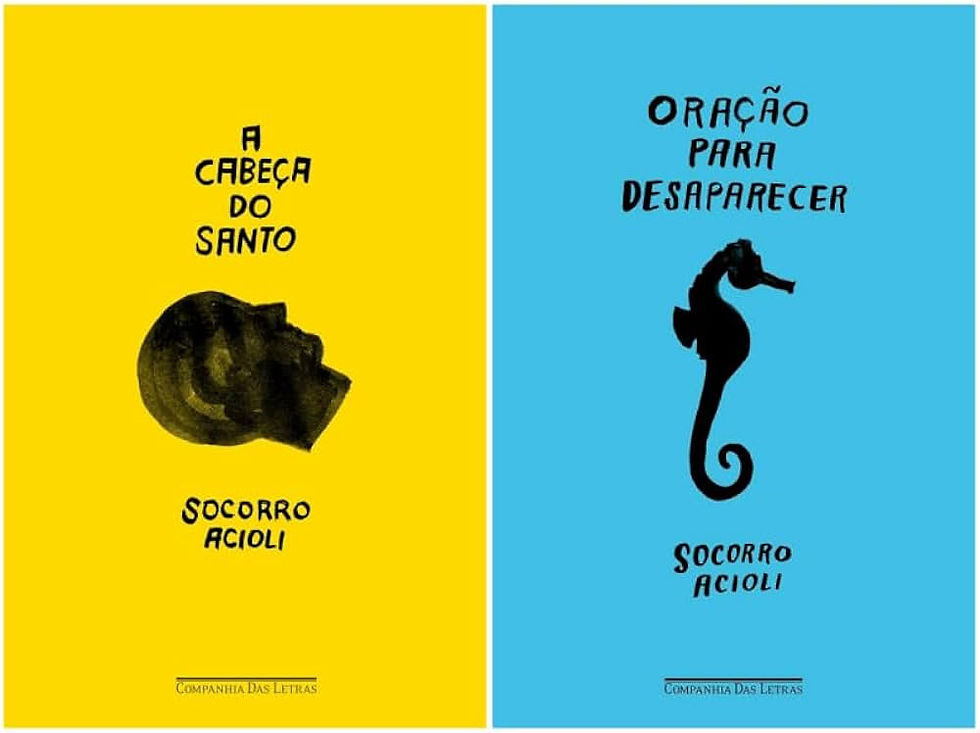
Perhaps you haven’t come across these two colorful books yet, but they are part of the work of the brilliant Socorro Acioli, who, for me and for many others, is one of the greatest writers of magical realism in Brazilian literature.
Magical realism is a literary style that is very characteristic of Latin America. Gabriel García Márquez is the great name of the genre, and I strongly recommend reading One Hundred Years of Solitude, one of my favorite books.
For me, the best way to explain the genre (besides diving into a book) is to think about the stories you grew up hearing. My grandmother always told me about a man who visited the women in my family across different generations. She said I should know that at some point, he would appear to me. This man, in fact, was an angel sent to Earth to see whether my heart was good. If I helped him, I would receive a rose as a reward, a rose that would never die. My grandmother said she had experienced this, as had her mother and her grandmother. The rose? It would eventually be lost, such are the ways of fantastical stories.
I must say that to this day I wonder whether it wasn’t a bit reckless of me to move continents before the man showed up at my address. All that’s left is to hope he has access to my Anmeldung and can find me in one of the many zip codes I have had here in Berlin.

In addition to trending on the MEC Livros platform, A Cabeça do Santo was announced as the theme for the 2027 Carnival of Unidos da Tijuca. Taking that as a cue, besides recommending both books, I also recommend a few literary parades:
The 2024 Portela parade with the theme Um Defeito de Cor
The 2023 Imperatriz Leopoldinense parade with the theme O aperreio do cabra que o excomungado tratou com má-querença e o santíssimo não deu guarida. The parade told the story of Lampião and featured one of my favorite comissões de frente (Front Commission).
Reading, leisure, and the right to rest
I hope you leave this column inspired to read even more. And no, I haven’t forgotten that I mentioned May 1st and the so-called revolution that I believe is taking place in reading.
Regarding the date, I think we should remember how revolutionary it is to do something for pleasure and personal enrichment, in a context that teaches us to do three things at once, listen to audio at double speed, and believe that everything must benefit our work. I know it is a privilege to be able to talk about this, but I think that, as immigrants, it is important to remember the rights we have. I hope you come away from this reading understanding literature as one of them.
Moreover, we must not forget the struggles and revolutions that still need to happen at home, in Brazil. Ending the 6x1 work schedule is more than an economic and labor change, it is a shift toward guaranteeing quality of life and rest time for working people. I invite you to invest your energy during this holiday in talking about this with friends and family.
And as for the revolution, I have seen more and more women fearlessly sharing their fantasy readings, book clubs, TikTok comments, and so on. I truly believe that, despite the recent discouraging data, existing readers have been coming together to further promote this art form. I also believe that the shock of bookstore closures and the low number of readers has made us realize how petty it is to measure the quality of a story. I hope you are happy reading what you love. If you’ve read this far, believe me: you are, indeed, a reader.
See you in the next one!


suas palavras sempre me fazem sorrir porque a sua escrita é tão naturalmente engraçada e linda ao mesmo tempo